
Metal Roofing
Metal Roof Installation in Evansville, IN
Standing seam, exposed fastener panels, and DECRA stone-coated shingles, documented every step.
Financing is available. Ask us for details when you request your inspection or quote.
Request your metal roof quote
We start with a short conversation about your roof and budget, then a free onsite inspection, then a written quote that specifies every component.
HomeVenture Roofing installs metal roofing for residential and commercial buildings in Evansville, Newburgh, Boonville, Mount Vernon, Wadesville, Henderson, Owensboro, and the surrounding communities within a 45-minute drive of Evansville. We install three formats: standing seam, exposed fastener panels, and stone-coated metal shingles. Every metal roof gets a written specification covering panel, gauge, finish, attachment, underlayment, and flashing details before you sign, plus photo documentation at every step of the install.
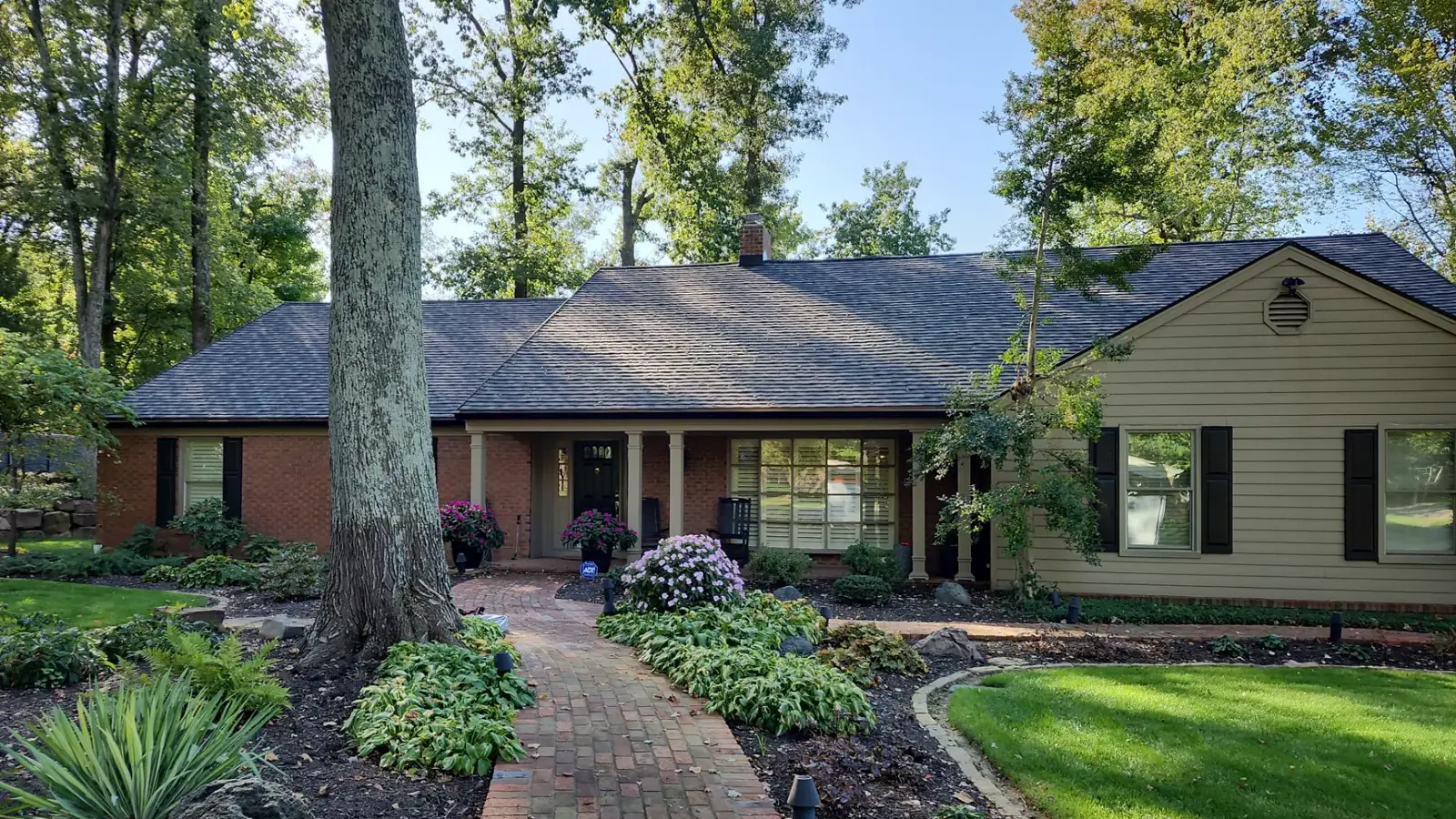
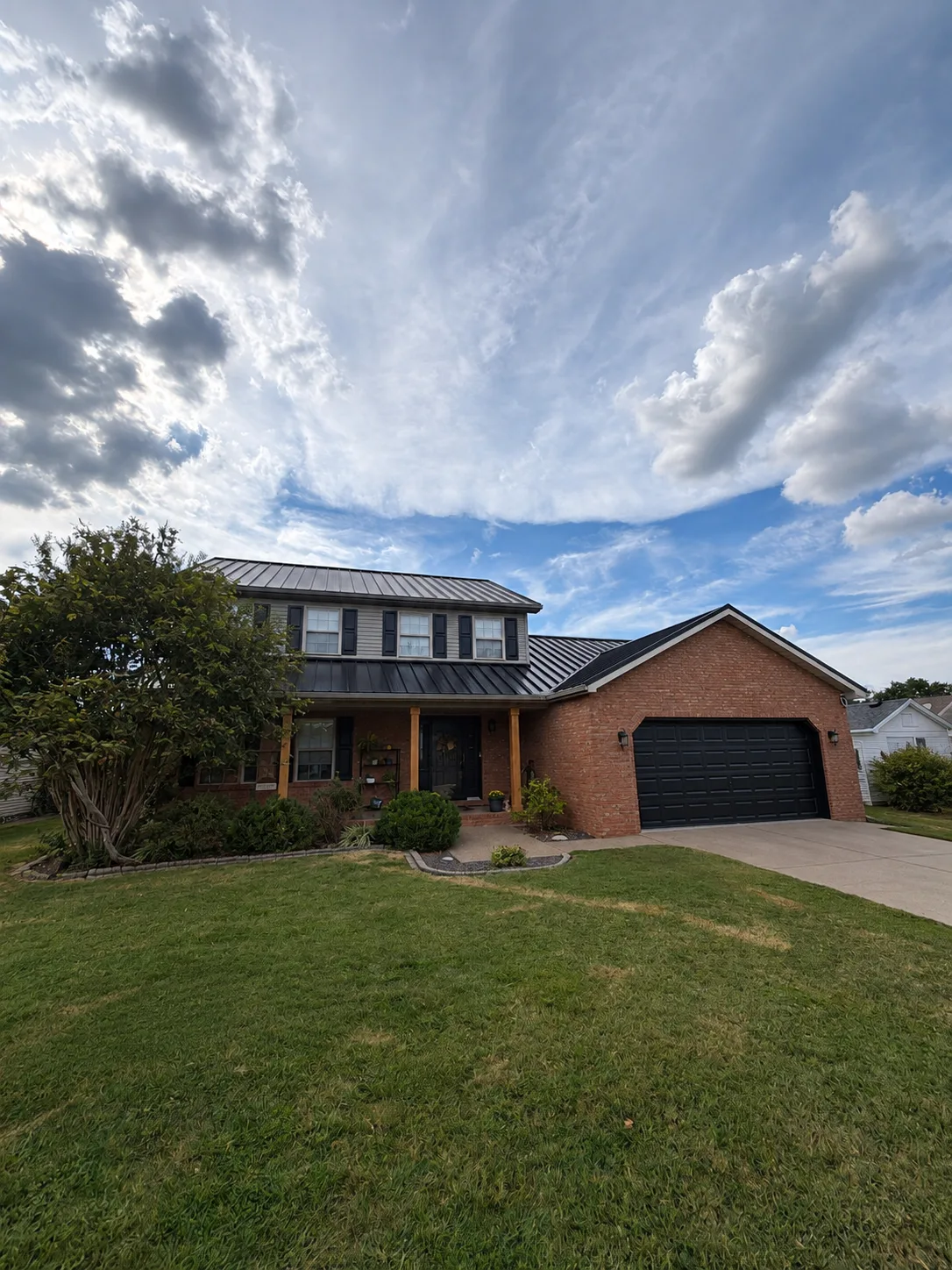
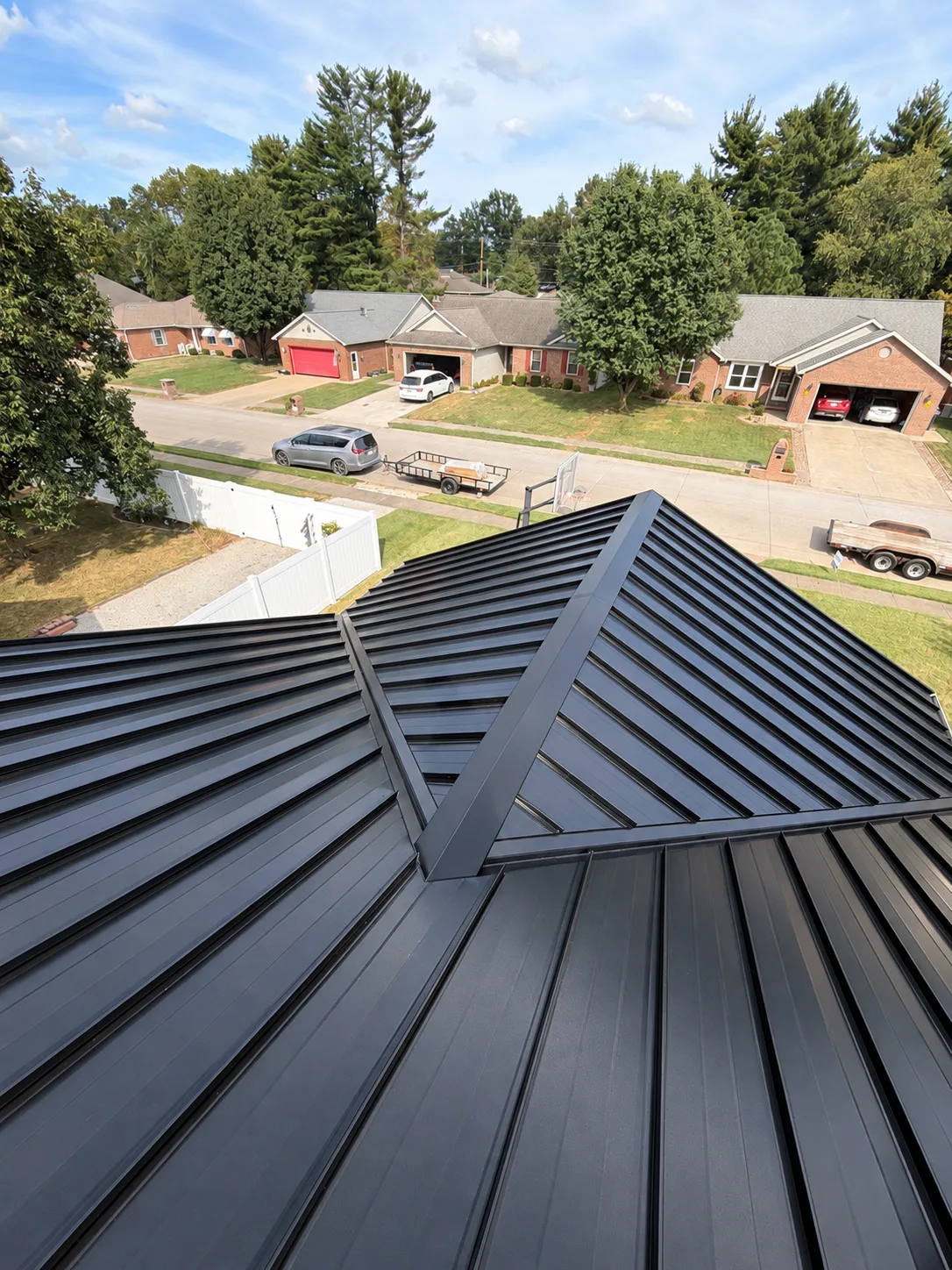
Metal roofs we installed in the Tri-State.
Real HomeVenture projects, photographed on site. Standing seam and DECRA stone-coated steel.


Three kinds of metal roof, and we install all three
Metal roofing is not one product. In this market you will encounter three formats, and they look, install, and age differently. The gauge of the steel, the paint system, and how the panels attach change the price, the look, and how the roof ages. We install all three, so the comparison below has no thumb on the scale.
What it is
- Standing seam panels
- Long concealed-fastener panels roll-formed at the jobsite
- Exposed fastener panels
- Ribbed screw-down panels (ag panel, R panel)
- Stone-coated metal shingles
- Interlocking steel shingle, shake, or tile pieces with a bonded stone-granule finish
Look
- Standing seam panels
- Clean vertical lines; reads as metal
- Exposed fastener panels
- Classic ribbed profile
- Stone-coated metal shingles
- Imitates shingles, shake, slate, or tile; does not read as metal from the street
Fasteners
- Standing seam panels
- Concealed; no exposed field fasteners
- Exposed fastener panels
- Exposed, with sealing washers
- Stone-coated metal shingles
- Concealed under the overlapping course above
Finish
- Standing seam panels
- Factory paint system (PVDF or SMP) over Galvalume steel
- Exposed fastener panels
- SMP paint over Galvalume steel
- Stone-coated metal shingles
- Acrylic-bonded stone granules over coated steel; the granular surface ages differently than paint
Panel preparation
- Standing seam panels
- Roll-formed at the jobsite
- Exposed fastener panels
- Cut to ordered lengths and delivered
- Stone-coated metal shingles
- Factory-formed pieces delivered to the jobsite
Maintenance
- Standing seam panels
- No exposed field fasteners; periodic roof inspection still applies
- Exposed fastener panels
- Field fasteners and washers are an added inspection point
- Stone-coated metal shingles
- No exposed field fasteners; periodic roof inspection still applies
Best fit
- Standing seam panels
- Long-term owners who want the metal look and no exposed fasteners
- Exposed fastener panels
- Value metal for homes, outbuildings, shops, and low slopes
- Stone-coated metal shingles
- Homeowners who want metal performance with a traditional roof appearance
Relative cost
- Standing seam panels
- Premium
- Stone-coated metal shingles
- Premium
What we install
- Standing seam panels
- 24 or 26 gauge, roll-formed onsite
- Exposed fastener panels
- 29 gauge ag panel; 26 gauge R panel
- Stone-coated metal shingles
- DECRA stone-coated steel systems
Steel and finish options above are what HomeVenture offers. Other combinations exist in the market; these are the systems we install and stand behind.
All three are legitimate roofs. The right one depends on the building, the budget, and how long you want to go between thinking about your roof. The free inspection covers which one fits.
If you have seen advertising for metal roofs that look like shingles, those are stone-coated metal shingles, and yes, we install them: our stone-coated work is DECRA, a long-established stone-coated steel manufacturer. If you want a roof that reads as metal, standing seam or exposed fastener is the answer. Whichever format fits your house, you get the same written specification, the same photo-documented installation, and the same closeout file. The free inspection includes the format conversation, and we will tell you which one fits even when it is not the one you walked in asking about.
Deciding between materials rather than between metal formats? Compare metal roofing with asphalt shingles.
What you are really paying for
A metal roof costs more up front than shingles. Here is what the extra money buys.
Fewer roofs over your lifetime in the house. A well-built shingle roof lasts a few decades. A well-built metal roof usually lasts much longer. If you plan to stay, you may never replace the roof again.
Less to think about. Standing seam has no exposed screws to check. The panels shed water, snow, and debris.
A roof built from a written plan. You get the exact panel, thickness, finish, and flashing details in writing before we start, and photos of every step.
When metal is the right call: you plan to stay 15 years or more, you want a roof you rarely think about, you have low-slope sections, or you want the look.
When shingles are the better call: you may sell in the next 10 to 15 years, budget is the main constraint, or the neighborhood look is shingles. We install both, and we will tell you which fits.
The same documentation discipline
- Written spec before you sign: panel system, gauge, finish, attachment method, underlayment, and flashing details, all in the proposal so you are never guessing which version of a metal roof you are getting
- Photo documentation at every step, same as our shingle installs
- Residential and commercial buildings, solid decks and open framing, same standard on both
- Closeout file: approved scope, product information, and installation photos organized in the project file you keep
What every Evansville metal roof proposal should state
Use this as a buyer's checklist against any metal roofing proposal you are holding, ours included. If a line item is missing, ask for it in writing before you sign.
- Panel profile and manufacturer
- Gauge of the steel
- Substrate coating
- Paint system
- Panel width
- Seam or fastening system
- Tested assembly the roof is built to
- Attachment substrate
- Underlayment
- Ventilation or condensation control
- Flashing details at every transition
- Penetrations and trim
- Exposed-fastener washer type where applicable
- Warranty documents you receive at closeout
- Photo checkpoints during the install
HomeVenture puts every one of these in writing before you sign.
Can a metal roof go over existing shingles?
Sometimes. A manufacturer-approved retrofit may allow a metal roof over an existing shingle layer when local code, the existing roof condition, the structure, and the exact roof assembly permit it. HomeVenture does not offer metal-over-shingle reroofs. We remove the shingles and document the deck before specifying the new attachment.
- We expose concealed conditions. Tear-off lets us find soft decking, rot, past leak damage, and uneven areas before a long-life roof system covers them.
- We verify the attachment substrate. The proposal states what the new system attaches to and how. That decision starts with conditions we can inspect and photograph.
- We rebuild transitions from the deck up. Eaves, walls, valleys, and penetrations are detailed for the selected metal system instead of being adapted around an added roof layer.
The result is a documented deck, a written attachment method, and photos of the conditions beneath the finished roof.
If you receive a proposal for metal over shingles, ask how the contractor will verify the existing deck and document the substrate or framing that carries the new system. Our process answers that question with tear-off, inspection, and photos you keep.
Explore all three metal roofing systems
Standing seam panels, exposed fastener panels, and DECRA stone-coated metal shingles. Each system has its own page with the full specification.
Standing Seam
Concealed fasteners, roll-formed at the jobsite, 24 or 26 gauge, PVDF or SMP finishes.
Standing seam detailsExposed Fastener
Two panel systems: 29-gauge ag panel for houses and outbuildings, 26-gauge R panel for commercial buildings and low slopes.
Exposed fastener detailsMetal Shingles
DECRA stone-coated steel in shingle, shake and tile profiles. Traditional appearance, profile-specific attachment and the highest cost position in our metal lineup.
Metal shingle detailsIf your building has a flat or low-slope section, our flat roofing membrane systems may be part of the conversation as well.
How wind resistance actually works on a metal roof
A metal roof does not have one universal wind-speed rating. The panel, the clips or screws, the deck or framing, and the spacing between fasteners all work together as one tested assembly. Your proposal identifies the tested assembly your roof is built to, and the installation photos show the attachment as it was done.
Frequently asked questions
Questions about metal roofing
Do you install metal roofs on houses, or just barns and garages?
Houses, commercial buildings, barns, garages, and outbuildings. Standing seam is the premium option. Exposed fastener panels are a legitimate cost-effective choice for houses as well as outbuildings and commercial structures. The tradeoffs are exposed fasteners and lighter-gauge steel on the ag panel, and we spell those out before you decide.
Is a metal roof better than shingles?
Different, not automatically better. Metal typically lasts longer and sheds weather well. Architectural shingles cost less up front and carry strong manufacturer warranties. We install both, so the recommendation you get is based on your building and budget, not on what we happen to sell.
What's the difference between the metal roofs I see on buildings around Evansville?
Mostly four things: gauge (thickness of the steel), paint system (PVDF holds color longer than SMP), whether the fasteners are concealed or exposed, and how the flashing details are executed. Two metal roofs can look similar on day one and age very differently. The spec sheet tells you which one you're actually buying, which is why ours is in writing.
Do metal roofs work with insurance claims?
Metal-roof damage can be part of a covered insurance claim, but coverage depends on the cause of loss and the specific policy. Some policies limit or exclude cosmetic denting that does not affect function. We document the roof condition and storm damage with photos and provide the written repair or replacement scope. The insurance carrier makes the coverage decision.
What makes one metal roof quote cost more than another?
The system itself (standing seam or exposed fastener), the gauge of the steel, the finish, the geometry of the roof, the length and number of panel runs, substrate preparation, the flashing scope, underlayment, trim, the number of penetrations, site access, and which tested assembly the roof is built to. Two quotes that both say metal roof can describe very different roofs, which is why our proposal states each of those items in writing.
How do I compare metal roofing contractors in Evansville?
Ask each contractor for the exact panel manufacturer and profile, the gauge, the paint system, the seam or fastening system, the substrate and attachment method, the tested assembly, the minimum slope for the product, written flashing details, the ventilation or condensation control plan, project photos of comparable work, the warranty documents you will receive, and who performs quality control on the crew. HomeVenture puts every one of those in the written proposal before you sign.
What do people mean by a tin roof today?
What homeowners around here call a tin roof is almost always coated steel: a Galvalume substrate with a factory paint system. Actual tin has not been a residential roofing material for a very long time, but tin roof is common local vocabulary. Usually it refers to an exposed fastener ribbed panel, the kind you see on barns and shops, and sometimes to standing seam. Both are systems we install.
Is a steel roof the same as a metal roof?
In this market, yes, almost always. Residential metal roofing is nearly all coated steel: a Galvalume substrate (steel with an aluminum-zinc alloy coating) under a factory paint system, or, for stone-coated shingles, under a bonded granule finish. When homeowners say steel roof, tin roof, or metal roof, they usually mean the same coated-steel base. Aluminum and copper exist but are uncommon on Evansville homes. Every HomeVenture metal proposal names the exact substrate, gauge, and finish system so there is no ambiguity.
Have a question not covered here? Contact us or call 812-461-1887.
Find out which metal system fits your building
The free inspection covers roof geometry, pitch, substrate, and flashing conditions, then we put the recommended system in writing so you can compare it against anything else you're holding.